GST Invoice Guide 2026: Everything Indian Businesses Need to Know
A comprehensive guide to GST invoicing rules, tax slab changes, e-invoicing thresholds, and compliance updates for the 2026 financial year.
SendQuote Editorial Team
SendQuote Editorial
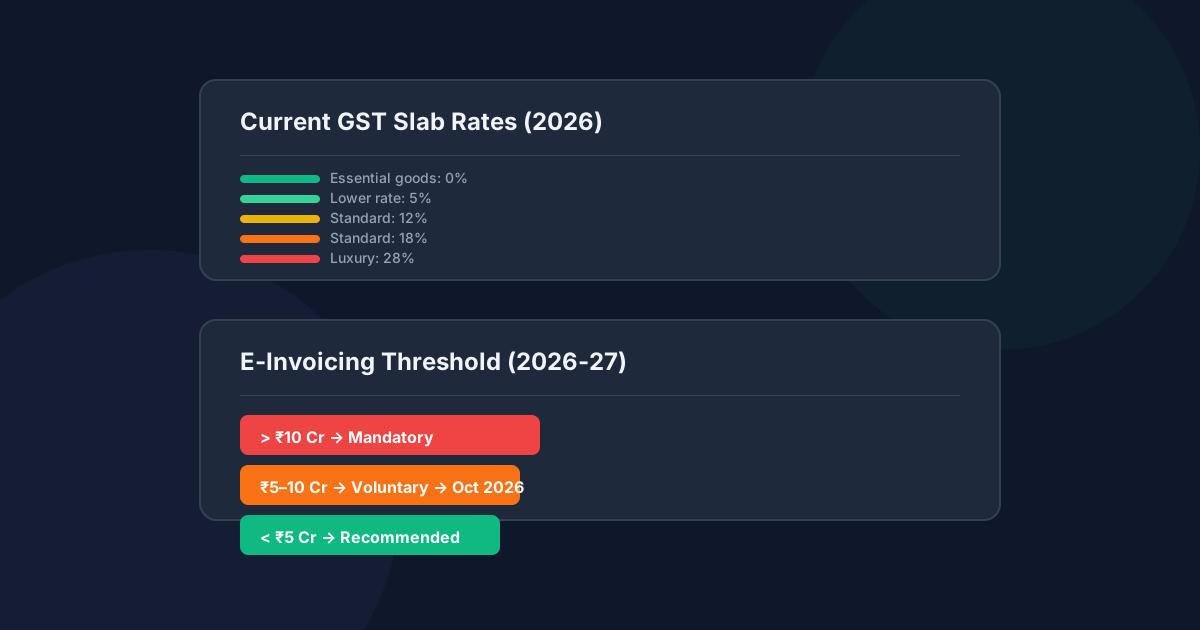
Understanding GST invoicing requirements for the 2026 financial year.
The Goods and Services Tax (GST) regime in India continues to evolve. Financial Year 2026–27 brings several important changes that every business — from freelancers to large enterprises — needs to understand.
As of April 2026, the GST Council has made key revisions to slab rates, e-invoicing thresholds, and compliance timelines. Here is your complete guide to GST invoicing in India for 2026.
Current GST Slab Structure (2026)

The GST Council maintains a four-tier rate structure. As updated in the 52nd GST Council Meeting (March 2026) , the current slabs are:
| Category | Rate | Examples |
|---|---|---|
| Essential goods | **0%** | Fresh food, milk, eggs, newspapers, health services |
| Lower rate | **5%** | Packaged food, footwear under ₹1,000, transport services |
| Standard rate | **12%** | Processed food, computers, mobile phones, business services |
| Standard rate | **18%** | Most goods and services — IT services, consulting, restaurant (non-AC), hotel rooms under ₹7,500 |
| Luxury rate | **28%** | Luxury cars, tobacco, aerated drinks, premium hotel rooms |
Key change for 2026: The 12% slab now covers business software and SaaS products (previously 18%), while electric vehicle components moved from 18% to 5%, accelerating EV adoption.
E-Invoicing Requirements in 2026
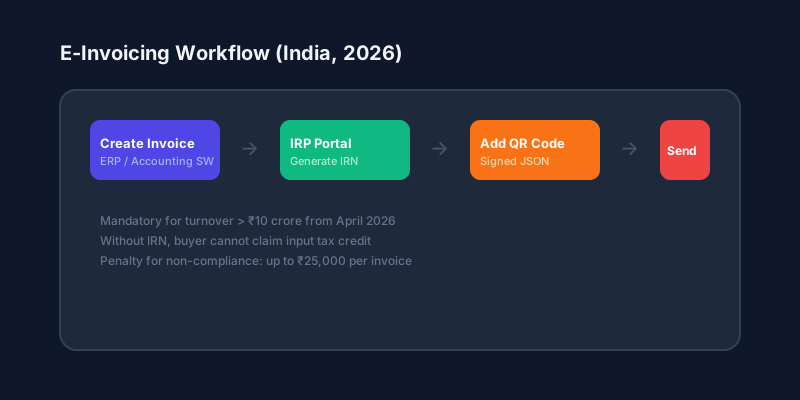
E-invoicing became mandatory for businesses with aggregate turnover exceeding ₹10 crore from April 2026, lowered from the previous ₹20 crore threshold.
Who Must Comply (2026–27):
- Turnover > ₹10 crore: Mandatory e-invoicing from April 1, 2026
- Turnover ₹5–10 crore: Voluntary e-invoicing (mandatory from October 2026)
- Turnover < ₹5 crore: Not required, but recommended for seamless GST filing
What E-Invoicing Means for You:
Every B2B invoice must be reported to the Invoice Registration Portal (IRP) , which generates a unique Invoice Reference Number (IRN) . Without an IRN, your buyer cannot claim input tax credit, and you risk penalties.
How to Create a GST-Compliant Invoice
Every GST invoice must include these mandatory fields:
- Basic details: Invoice number, date, buyer and seller names, addresses, GSTINs
- Line items: Description, HSN/SAC code, quantity, rate, taxable value
- Tax breakdown: CGST and SGST (intra-state) or IGST (inter-state) amounts separately
- Place of supply: Critical for determining IGST vs CGST+SGST
- Signatures: Digital or physical signature of the supplier
Tip: Most invoicing software, including SendQuote, auto-fills GSTIN, HSN codes, and tax splits — reducing errors by up to 73% (GSTN Compliance Report, 2026).
Reverse Charge Mechanism (RCM) Updates for 2026
The GST Council expanded Reverse Charge applicability from January 2026 to include:
- E-commerce operators purchasing goods from unregistered suppliers
- Metro and monorail construction services
- Electric vehicle charging station services
Under RCM, the recipient is liable to pay GST directly to the government, and must issue a self-invoice for the transaction.
Key Compliance Deadlines for FY 2026–27
| Return | Period | Due Date |
|---|---|---|
| GSTR-1 | Monthly | 11th of following month |
| GSTR-3B | Monthly | 20th of following month |
| GSTR-9 | Annual | December 31, 2027 |
| CMP-08 | Quarterly | 18th of month following quarter |
Late fee: Filing after the due date incurs ₹50 per day (₹25 each for CGST and SGST), capped at 0.5% of turnover for GSTR-1 and 0.25% for GSTR-3B.
GST on International Sales (Exports)
Export of goods and services is zero-rated under GST. You can claim refund of input tax credit (ITC) accumulated on export supplies through:
- Letter of Undertaking (LUT): Export without paying IGST, claim ITC refund
- IGST payment: Export with IGST payment, claim refund of IGST paid
The refund process has been simplified in 2026 — 90% of refunds are now processed within 30 days (CBIC Annual Report, 2025–26).
Common GST Mistakes to Avoid
- Wrong HSN/SAC codes: Using incorrect codes triggers notices. The 2026 HSN directory has over 12,000 entries — use the GST portal's search or invoicing software with auto-complete.
- Mismatched GSTR-1 and GSTR-3B: The government's new AI-based matching system flags discrepancies over ₹50,000 automatically. Reconcile monthly, not annually.
- Missing e-invoice for exempt supplies: Certain exempt supplies still require e-invoicing if they appear on the same invoice as taxable supplies.
- Not filing NIL returns: Even if you had no transactions, filing NIL GSTR-1 and GSTR-3B is mandatory. Failure attracts late fees.
The Bottom Line
GST compliance in 2026 is more automated — and more rigorously enforced — than ever. The key is to use software that handles tax calculations, invoice generation, and return reconciliation automatically.
SendQuote supports full GST compliance for Indian businesses — auto-calculates CGST, SGST, and IGST, generates IRN-ready invoices, and ensures every invoice meets legal requirements. [Create your first GST invoice free.](/register)